> ## Documentation Index
> Fetch the complete documentation index at: https://sa-e12ee2af.mintlify.site/llms.txt
> Use this file to discover all available pages before exploring further.
# Introduction to Security Engineering
> Comprehensive introduction to security engineering fundamentals, including threat vectors, core principles, and practical implementation approaches for building secure systems
 **Security engineering** represents a specialized discipline that focuses on designing, implementing, and testing systems to remain dependable in the face of **malice**, **error**, or **mischance**. This foundational definition, attributed to Ross Anderson in his seminal work [*Security Engineering: A Guide to Building Dependable Distributed Systems*](https://www.cl.cam.ac.uk/~rja14/book.html), encapsulates the unique challenges that distinguish security engineering from conventional engineering disciplines.
Unlike traditional engineering fields that primarily address natural forces and material limitations, security engineering operates in an **adversarial environment** where systems must withstand deliberate attacks from intelligent adversaries with evolving capabilities. This adversarial context fundamentally shapes how security engineers approach system design, implementation, and operation.
## Understanding Security Engineering
**Security engineering** encompasses the systematic application of scientific and mathematical principles to address security concerns throughout a system's entire lifecycle. The discipline extends beyond traditional engineering by incorporating elements of psychology, economics, and law to create comprehensive security solutions that account for human factors and organizational dynamics.
### The Three Threat Vectors
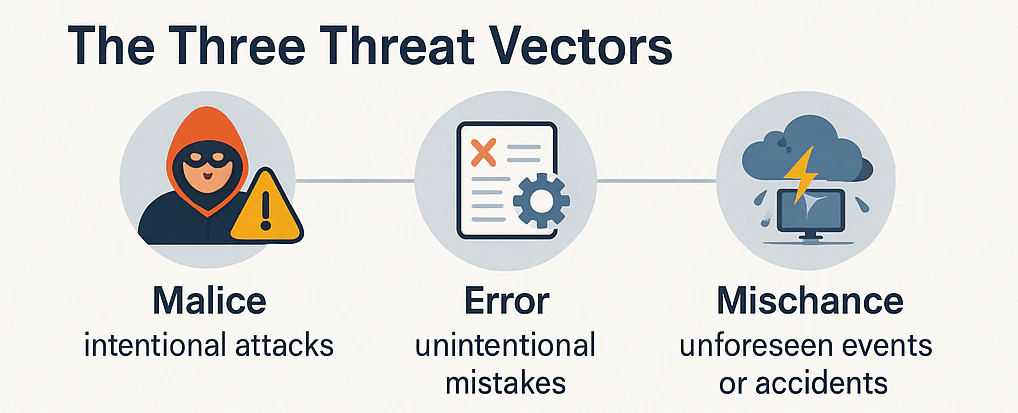
The three critical threat vectors identified by Anderson form the foundation of security engineering practice:
* **Malice** represents intentional attacks by adversaries seeking to compromise systems for various motivations including financial gain, espionage, or disruption. According to the [2023 Verizon Data Breach Investigations Report](https://www.verizon.com/business/resources/T628/reports/2023-dbir-executive-summary.pdf), **95 % of breaches** were financially motivated and **83 %** involved external actors .
* **Error** encompasses unintentional mistakes by designers, developers, or users that create vulnerabilities—often through misconfigurations, coding flaws, or operational oversights. The [2023 State of Software Security Report](https://www.veracode.com/rs/790-ZKW-291/images/Veracode_State_of_Software_Security_2023.pdf) found that **74.1 % of applications** contain at least one security flaw, with **19.2 %** containing high-severity vulnerabilities .
* **Mischance** covers unforeseen events or accidents such as hardware failures, natural disasters, or unexpected system interactions that can impact security posture. In the Uptime Institute's [2023 Global Data Center Survey](https://uptimeinstitute.com/uptime_assets/7425ec68d479c5d78a743df94a79b114ed9f9c73f13b6460949d2b8e73373209-GA-2024-07-uptime-institute-global-data-center-survey-results-2024.pdf), **four in five (80 %)** respondents said their most recent serious outage could have been prevented with better management or processes .
**Security engineering** represents a specialized discipline that focuses on designing, implementing, and testing systems to remain dependable in the face of **malice**, **error**, or **mischance**. This foundational definition, attributed to Ross Anderson in his seminal work [*Security Engineering: A Guide to Building Dependable Distributed Systems*](https://www.cl.cam.ac.uk/~rja14/book.html), encapsulates the unique challenges that distinguish security engineering from conventional engineering disciplines.
Unlike traditional engineering fields that primarily address natural forces and material limitations, security engineering operates in an **adversarial environment** where systems must withstand deliberate attacks from intelligent adversaries with evolving capabilities. This adversarial context fundamentally shapes how security engineers approach system design, implementation, and operation.
## Understanding Security Engineering
**Security engineering** encompasses the systematic application of scientific and mathematical principles to address security concerns throughout a system's entire lifecycle. The discipline extends beyond traditional engineering by incorporating elements of psychology, economics, and law to create comprehensive security solutions that account for human factors and organizational dynamics.
### The Three Threat Vectors
The three critical threat vectors identified by Anderson form the foundation of security engineering practice:
* **Malice** represents intentional attacks by adversaries seeking to compromise systems for various motivations including financial gain, espionage, or disruption. According to the [2023 Verizon Data Breach Investigations Report](https://www.verizon.com/business/resources/T628/reports/2023-dbir-executive-summary.pdf), **95 % of breaches** were financially motivated and **83 %** involved external actors .
* **Error** encompasses unintentional mistakes by designers, developers, or users that create vulnerabilities—often through misconfigurations, coding flaws, or operational oversights. The [2023 State of Software Security Report](https://www.veracode.com/rs/790-ZKW-291/images/Veracode_State_of_Software_Security_2023.pdf) found that **74.1 % of applications** contain at least one security flaw, with **19.2 %** containing high-severity vulnerabilities .
* **Mischance** covers unforeseen events or accidents such as hardware failures, natural disasters, or unexpected system interactions that can impact security posture. In the Uptime Institute's [2023 Global Data Center Survey](https://uptimeinstitute.com/uptime_assets/7425ec68d479c5d78a743df94a79b114ed9f9c73f13b6460949d2b8e73373209-GA-2024-07-uptime-institute-global-data-center-survey-results-2024.pdf), **four in five (80 %)** respondents said their most recent serious outage could have been prevented with better management or processes .
 ### Security Engineering vs. Security Implementation
Security engineering differs fundamentally from simply implementing security products or following compliance checklists. It represents a **proactive, systematic approach** that integrates security considerations from initial system conception through design, development, deployment, operation, and eventual decommissioning. This lifecycle integration ensures that security becomes an **inherent property** of the system rather than an afterthought.
### Security Engineering vs. Security Implementation
Security engineering differs fundamentally from simply implementing security products or following compliance checklists. It represents a **proactive, systematic approach** that integrates security considerations from initial system conception through design, development, deployment, operation, and eventual decommissioning. This lifecycle integration ensures that security becomes an **inherent property** of the system rather than an afterthought.
 ### Core Security Engineering Activities
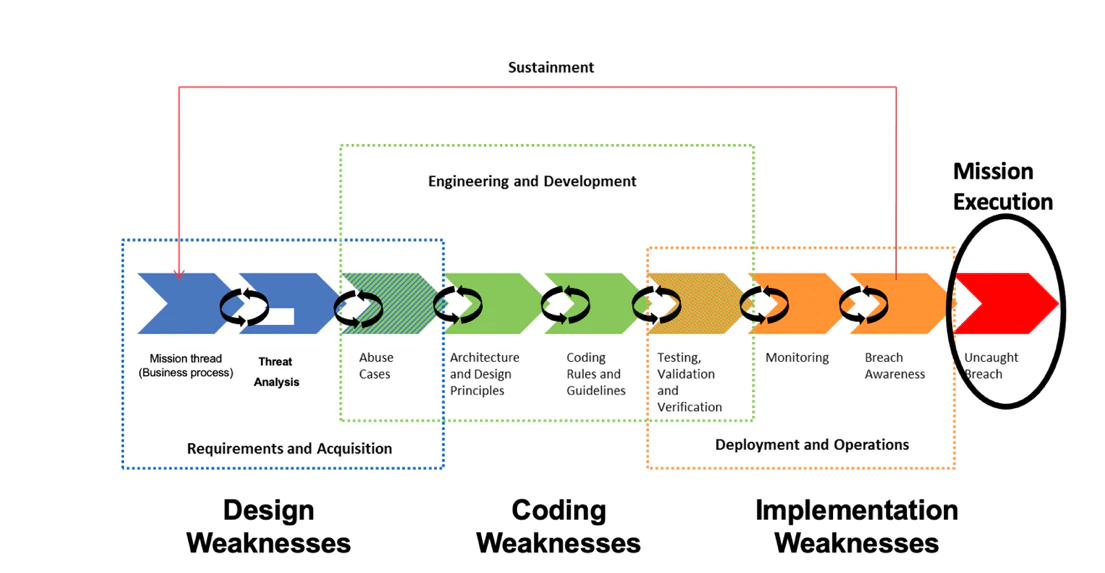
The discipline encompasses several interconnected activities that work together to create secure systems:
**Threat Modeling and Risk Assessment** form the analytical foundation, enabling security engineers to identify potential adversaries, understand their capabilities and motivations, and anticipate the attacks they might launch. The [MITRE ATT\&CK framework](https://attack.mitre.org/) documents over **200 attack techniques** across **14 tactics**, providing a comprehensive knowledge base for threat analysis.
**Security Architecture** builds upon this analysis to design systems with built-in security controls that embody principles such as **defense-in-depth** and **least privilege**. According to [Gartner's 2023 Security Architecture Survey](https://www.gartner.com/en/information-technology/insights/security), organizations with mature security architectures experience **45% fewer security incidents** than those without.
**Secure Implementation** translates architectural designs into reality through secure development practices, proper cryptographic implementations, and secure system configurations. The [OWASP Top 10](https://owasp.org/www-project-top-ten/) identifies the most critical web application security risks, with **injection flaws** and **broken authentication** remaining persistent implementation challenges.
**Security Testing** rigorously evaluates systems through methods including penetration testing, code reviews, and formal verification to identify vulnerabilities before deployment. Research by the [Ponemon Institute](https://www.ponemon.org/) shows that fixing vulnerabilities during development costs **6 times less** than fixing them in production.
**Security Monitoring and Response** establish mechanisms to detect, respond to, and recover from security incidents in operational environments. The [IBM Cost of a Data Breach Report 2023](https://www.ibm.com/reports/data-breach) found that organizations with **mature incident response capabilities** save an average of **\$2.66 million** compared to those without.
## Real World - Security in Current Times
The modern cybersecurity landscape presents unprecedented challenges and opportunities, with organizations facing evolving threats while navigating complex technological environments. Understanding current trends, incident patterns, and market dynamics is essential for effective security engineering practice.
### Incidents
Real-world security incidents demonstrate the tangible impact of cybersecurity challenges on organizations worldwide:
**Financial Impact:**
* The [IBM Cost of a Data Breach Report 2023](https://www.ibm.com/reports/data-breach) found the global average cost of a data breach reached **\$4.45 million**
* The [Ponemon Institute's 2023 Cost of Cybercrime Study](https://www.ponemon.org/) found that the average cost of cybercrime for organizations increased by **15.3%** year-over-year, reaching **\$15.6 million** per organization
* The [Ponemon Institute's 2023 Cost of a Data Breach Report](https://www.ponemon.org/) found that organizations with **incident response teams** that regularly test their plans save an average of **\$1.49 million** in breach costs
**Human Factor Challenges:**
* The [Verizon 2023 Data Breach Investigations Report](https://www.verizon.com/business/resources/reports/dbir/) found that **74% of breaches** involved a human element, including social engineering, errors, or misuse
* Research from the [SANS Institute](https://www.sans.org/) found that **67% of security incidents** involve misconfigured security controls, highlighting the critical importance of proper implementation
**Threat Evolution:**
* According to the [ENISA Threat Landscape Report 2023](https://www.enisa.europa.eu/publications/enisa-threat-landscape-2023), the threat landscape continues to evolve rapidly, with **ransomware**, **supply chain attacks**, and **advanced persistent threats** presenting significant challenges to organizations worldwide
### Info
Current market dynamics and organizational trends shape the cybersecurity profession:
**Workforce and Skills:**
* The [ISC2 Cybersecurity Workforce Study 2023](https://www.isc2.org/Research/Workforce-Study) identified a global cybersecurity workforce gap of **4 million professionals**, emphasizing the need for efficient resource utilization
* According to the [ISC2 Cybersecurity Workforce Study 2023](https://www.isc2.org/Research/Workforce-Study), security architects command an average salary of **\$165,000** globally, reflecting the high demand for these specialized skills
**Market Growth:**
* Research by [Cybersecurity Ventures](https://cybersecurityventures.com/) predicts that the global penetration testing market will exceed **\$5 billion by 2031**, driven by increasing regulatory requirements and security awareness
**Organizational Maturity:**
* According to [Deloitte's 2023 Future of Cyber Survey](https://www2.deloitte.com/us/en/insights/topics/cyber-risk.html), organizations with **mature security governance** programs are **3.5 times more likely** to effectively respond to cyber threats
* Research by [McKinsey & Company](https://www.mckinsey.com/capabilities/risk-and-resilience/our-insights/cybersecurity) shows that organizations viewing security as a **business enabler** achieve **2.5 times higher** revenue growth compared to those treating it as a cost center
## The Security Engineering Mindset and Role
### The Security Engineering Mindset
Effective security engineering requires a mindset that constantly **questions assumptions**, **anticipates failure modes**, and **considers adversarial perspectives**. Security engineers must make informed trade-offs between security, usability, performance, and cost based on clear understanding of risks and asset values.
### The Security Engineer's Role
### Core Security Engineering Activities
The discipline encompasses several interconnected activities that work together to create secure systems:
**Threat Modeling and Risk Assessment** form the analytical foundation, enabling security engineers to identify potential adversaries, understand their capabilities and motivations, and anticipate the attacks they might launch. The [MITRE ATT\&CK framework](https://attack.mitre.org/) documents over **200 attack techniques** across **14 tactics**, providing a comprehensive knowledge base for threat analysis.
**Security Architecture** builds upon this analysis to design systems with built-in security controls that embody principles such as **defense-in-depth** and **least privilege**. According to [Gartner's 2023 Security Architecture Survey](https://www.gartner.com/en/information-technology/insights/security), organizations with mature security architectures experience **45% fewer security incidents** than those without.
**Secure Implementation** translates architectural designs into reality through secure development practices, proper cryptographic implementations, and secure system configurations. The [OWASP Top 10](https://owasp.org/www-project-top-ten/) identifies the most critical web application security risks, with **injection flaws** and **broken authentication** remaining persistent implementation challenges.
**Security Testing** rigorously evaluates systems through methods including penetration testing, code reviews, and formal verification to identify vulnerabilities before deployment. Research by the [Ponemon Institute](https://www.ponemon.org/) shows that fixing vulnerabilities during development costs **6 times less** than fixing them in production.
**Security Monitoring and Response** establish mechanisms to detect, respond to, and recover from security incidents in operational environments. The [IBM Cost of a Data Breach Report 2023](https://www.ibm.com/reports/data-breach) found that organizations with **mature incident response capabilities** save an average of **\$2.66 million** compared to those without.
## Real World - Security in Current Times
The modern cybersecurity landscape presents unprecedented challenges and opportunities, with organizations facing evolving threats while navigating complex technological environments. Understanding current trends, incident patterns, and market dynamics is essential for effective security engineering practice.
### Incidents
Real-world security incidents demonstrate the tangible impact of cybersecurity challenges on organizations worldwide:
**Financial Impact:**
* The [IBM Cost of a Data Breach Report 2023](https://www.ibm.com/reports/data-breach) found the global average cost of a data breach reached **\$4.45 million**
* The [Ponemon Institute's 2023 Cost of Cybercrime Study](https://www.ponemon.org/) found that the average cost of cybercrime for organizations increased by **15.3%** year-over-year, reaching **\$15.6 million** per organization
* The [Ponemon Institute's 2023 Cost of a Data Breach Report](https://www.ponemon.org/) found that organizations with **incident response teams** that regularly test their plans save an average of **\$1.49 million** in breach costs
**Human Factor Challenges:**
* The [Verizon 2023 Data Breach Investigations Report](https://www.verizon.com/business/resources/reports/dbir/) found that **74% of breaches** involved a human element, including social engineering, errors, or misuse
* Research from the [SANS Institute](https://www.sans.org/) found that **67% of security incidents** involve misconfigured security controls, highlighting the critical importance of proper implementation
**Threat Evolution:**
* According to the [ENISA Threat Landscape Report 2023](https://www.enisa.europa.eu/publications/enisa-threat-landscape-2023), the threat landscape continues to evolve rapidly, with **ransomware**, **supply chain attacks**, and **advanced persistent threats** presenting significant challenges to organizations worldwide
### Info
Current market dynamics and organizational trends shape the cybersecurity profession:
**Workforce and Skills:**
* The [ISC2 Cybersecurity Workforce Study 2023](https://www.isc2.org/Research/Workforce-Study) identified a global cybersecurity workforce gap of **4 million professionals**, emphasizing the need for efficient resource utilization
* According to the [ISC2 Cybersecurity Workforce Study 2023](https://www.isc2.org/Research/Workforce-Study), security architects command an average salary of **\$165,000** globally, reflecting the high demand for these specialized skills
**Market Growth:**
* Research by [Cybersecurity Ventures](https://cybersecurityventures.com/) predicts that the global penetration testing market will exceed **\$5 billion by 2031**, driven by increasing regulatory requirements and security awareness
**Organizational Maturity:**
* According to [Deloitte's 2023 Future of Cyber Survey](https://www2.deloitte.com/us/en/insights/topics/cyber-risk.html), organizations with **mature security governance** programs are **3.5 times more likely** to effectively respond to cyber threats
* Research by [McKinsey & Company](https://www.mckinsey.com/capabilities/risk-and-resilience/our-insights/cybersecurity) shows that organizations viewing security as a **business enabler** achieve **2.5 times higher** revenue growth compared to those treating it as a cost center
## The Security Engineering Mindset and Role
### The Security Engineering Mindset
Effective security engineering requires a mindset that constantly **questions assumptions**, **anticipates failure modes**, and **considers adversarial perspectives**. Security engineers must make informed trade-offs between security, usability, performance, and cost based on clear understanding of risks and asset values.
### The Security Engineer's Role
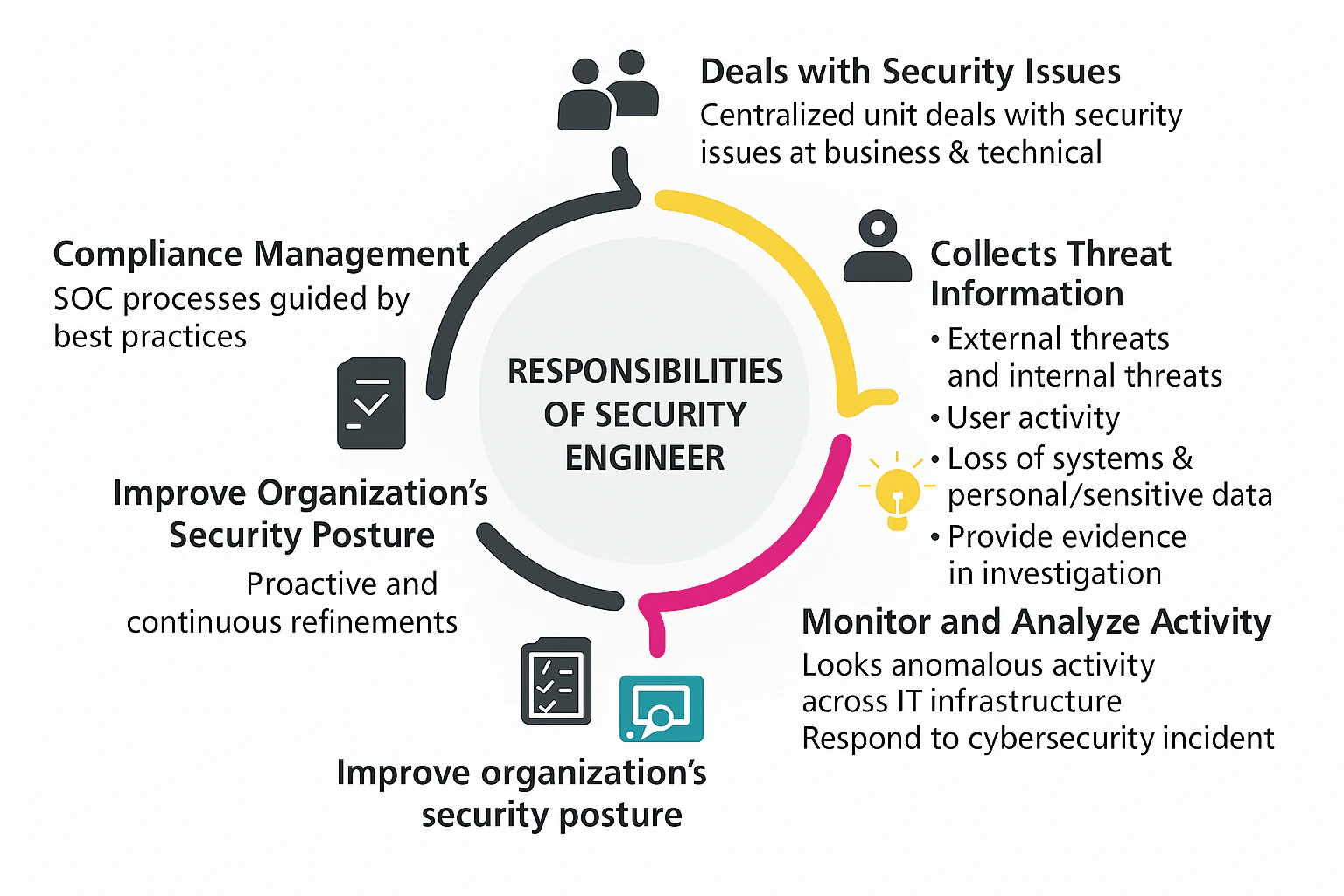 Security engineers serve as the **architects and guardians** of secure systems, with responsibilities spanning:
* **Security Architecture and Design:** Creating secure system architectures and selecting appropriate technologies
* **Implementation and Configuration:** Deploying security controls and hardening systems
* **Security Assessment and Validation:** Conducting vulnerability assessments and penetration testing
* **Incident Response and Recovery:** Developing response plans and investigating security incidents
* **Security Governance and Compliance:** Ensuring adherence to policies and regulatory requirements
The role demands a combination of **technical depth**, **analytical thinking**, and **communication skills** to effectively protect organizations against evolving threats.
## Conclusion
Security engineering represents a critical discipline for protecting modern systems against an increasingly sophisticated threat landscape. By combining theoretical foundations with practical implementation knowledge, security engineers help organizations navigate complex security challenges and build resilient systems that can withstand real-world threats.
The **systematic approach** to security engineering, encompassing threat analysis, secure design, implementation, testing, and ongoing monitoring, provides a framework for addressing security challenges throughout the system lifecycle. The role of security engineers continues to evolve as new technologies and threats emerge, requiring **continuous learning** and adaptation to maintain effective security postures.
Understanding current cybersecurity trends and real-world impacts enables security engineers to make informed decisions that balance security objectives with operational realities. This balance ensures that security investments provide tangible value while maintaining the usability and performance characteristics required for business success.
The subsequent sections of this chapter will explore the fundamental principles, frameworks, and methodologies that form the foundation of effective security engineering practice, building upon the conceptual foundation established in this introduction.
## References
* Anderson, R. (2020). [Security Engineering: A Guide to Building Dependable Distributed Systems, 3rd Edition](https://www.cl.cam.ac.uk/~rja14/book.html)
* NIST Special Publication 800-160 Vol. 1: [Systems Security Engineering](https://csrc.nist.gov/publications/detail/sp/800-160/vol-1/final)
* ISO/IEC 27001:2022: [Information Security Management Systems - Requirements](https://www.iso.org/standard/27001)
* Verizon. (2023). [2023 Data Breach Investigations Report](https://www.verizon.com/business/resources/reports/dbir/)
* IBM Security. (2023). [Cost of a Data Breach Report 2023](https://www.ibm.com/reports/data-breach)
* ENISA. (2023). [ENISA Threat Landscape Report 2023](https://www.enisa.europa.eu/publications/enisa-threat-landscape-2023)
* ISC2. (2023). [Cybersecurity Workforce Study 2023](https://www.isc2.org/Research/Workforce-Study)
* Ponemon Institute. (2023). [2023 Cost of Cybercrime Study](https://www.ponemon.org/)
* Veracode. (2023). [State of Software Security Report](https://www.veracode.com/state-of-software-security-report)
* Gartner. (2023). [Security Architecture Survey](https://www.gartner.com/en/information-technology/insights/security)
* McKinsey & Company. (2023). [Cybersecurity Insights](https://www.mckinsey.com/capabilities/risk-and-resilience/our-insights/cybersecurity)
Security engineers serve as the **architects and guardians** of secure systems, with responsibilities spanning:
* **Security Architecture and Design:** Creating secure system architectures and selecting appropriate technologies
* **Implementation and Configuration:** Deploying security controls and hardening systems
* **Security Assessment and Validation:** Conducting vulnerability assessments and penetration testing
* **Incident Response and Recovery:** Developing response plans and investigating security incidents
* **Security Governance and Compliance:** Ensuring adherence to policies and regulatory requirements
The role demands a combination of **technical depth**, **analytical thinking**, and **communication skills** to effectively protect organizations against evolving threats.
## Conclusion
Security engineering represents a critical discipline for protecting modern systems against an increasingly sophisticated threat landscape. By combining theoretical foundations with practical implementation knowledge, security engineers help organizations navigate complex security challenges and build resilient systems that can withstand real-world threats.
The **systematic approach** to security engineering, encompassing threat analysis, secure design, implementation, testing, and ongoing monitoring, provides a framework for addressing security challenges throughout the system lifecycle. The role of security engineers continues to evolve as new technologies and threats emerge, requiring **continuous learning** and adaptation to maintain effective security postures.
Understanding current cybersecurity trends and real-world impacts enables security engineers to make informed decisions that balance security objectives with operational realities. This balance ensures that security investments provide tangible value while maintaining the usability and performance characteristics required for business success.
The subsequent sections of this chapter will explore the fundamental principles, frameworks, and methodologies that form the foundation of effective security engineering practice, building upon the conceptual foundation established in this introduction.
## References
* Anderson, R. (2020). [Security Engineering: A Guide to Building Dependable Distributed Systems, 3rd Edition](https://www.cl.cam.ac.uk/~rja14/book.html)
* NIST Special Publication 800-160 Vol. 1: [Systems Security Engineering](https://csrc.nist.gov/publications/detail/sp/800-160/vol-1/final)
* ISO/IEC 27001:2022: [Information Security Management Systems - Requirements](https://www.iso.org/standard/27001)
* Verizon. (2023). [2023 Data Breach Investigations Report](https://www.verizon.com/business/resources/reports/dbir/)
* IBM Security. (2023). [Cost of a Data Breach Report 2023](https://www.ibm.com/reports/data-breach)
* ENISA. (2023). [ENISA Threat Landscape Report 2023](https://www.enisa.europa.eu/publications/enisa-threat-landscape-2023)
* ISC2. (2023). [Cybersecurity Workforce Study 2023](https://www.isc2.org/Research/Workforce-Study)
* Ponemon Institute. (2023). [2023 Cost of Cybercrime Study](https://www.ponemon.org/)
* Veracode. (2023). [State of Software Security Report](https://www.veracode.com/state-of-software-security-report)
* Gartner. (2023). [Security Architecture Survey](https://www.gartner.com/en/information-technology/insights/security)
* McKinsey & Company. (2023). [Cybersecurity Insights](https://www.mckinsey.com/capabilities/risk-and-resilience/our-insights/cybersecurity)